

Recording a podcast at home or in a similar space usually comes with two different problems: the sound of the room itself, and the sound from outside the room. When walls and floors reflect sound, the recording becomes hollow and echoey, even if you own an expensive microphone. But if traffic, neighbors, or the AC noise show up in your recording, the problem isn’t the room; it’s sound getting in. These two problems have two separate solutions. The first is controlled with acoustic treatment, meaning the use of best acoustic panels podcast studio, and the second with soundproofing, meaning blocking sound from passing through.
Because the two are so often confused, many podcasters buy panels and then find that outside noise is still on their recordings. In this guide, you’ll first learn which of the two problems you have. Then we compare the types of panels, look at where to install them, and explain how far home soundproofing can go, especially in Dubai apartments. If you need equipment other than panels, our complete Essential Podcasting Equipment guide gives you a good overview.
Acoustic Treatment vs. Soundproofing: What’s the Difference? (Short Answer First)
Acoustic treatment controls how sound behaves inside the room, meaning how much reflection and echo remain.
Soundproofing stops sound from passing between two spaces. Acoustic panels belong to the first category and, on their own, do not eliminate outside noise.
This difference is decisive in practice. The topic of acoustic panels vs soundproofing causes wrong purchases more than anything else. Through sound absorption, panels absorb part of the sound energy and reduce reverb and echo. Sound isolation, however, requires mass, sealing, and structural decoupling, which is a completely different job and costs more. So before searching for best acoustic panels podcast studio, you first need to know which of these two problems you have.
The table below helps you match the symptom to its likely cause:
| Symptom | Likely cause | What helps |
| The recorded voice sounds “hollow” or like a bathroom | Reverb and reflections in the room | Treatment |
| A sharp, metallic echo is heard when you clap | Flutter echo between parallel walls | Treatment |
| Traffic, neighbors, or hallway noise is heard in the recording | Sound passing through the wall, door, or window | Soundproofing |
| A constant, steady sound is present in the background | HVAC / split AC noise or appliances | Manage the noise source, then Both |
| The sound has both echo and outside noise | A combination of both problems | Both |
How to Diagnose Your Room in 5 Minutes
You don’t need specialized tools to diagnose the problem. Stand in the middle of the room, clap once firmly, and listen to the sound that remains. If the sound lingers or rings, the room has too many reflections. That said, this is easier to judge with the best headphones with a mic for podcasting.
Then record a thirty-second voice memo on your phone in complete silence and listen to it with headphones. Whatever you hear in this recording is the room’s noise floor. If background noise such as traffic or neighbors is clearly audible, the main problem is sound getting in, not reflection.
Types of Acoustic Panels Compared
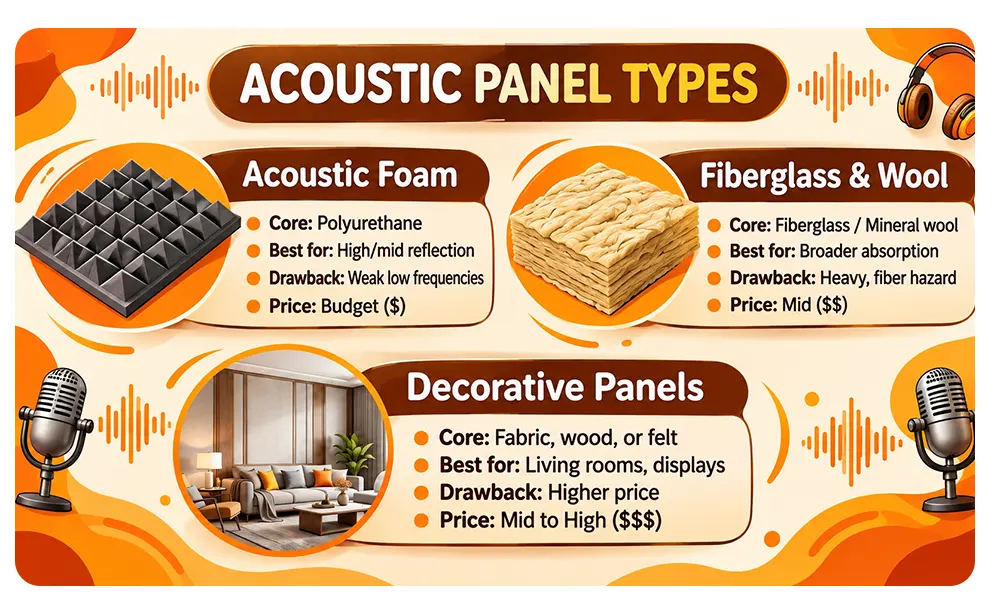
To find best acoustic panels podcast studio, you need to know that panels on the market fall into three main groups, and each group suits a different situation. The table below is a general comparison, and for your final choice you should check the manufacturer’s specifications.
| Panel type | Core material | Best for | Limitations | Price tier |
| Acoustic foam | Polyurethane foam | Low-cost start, controlling high and mid reflections | Weak at low frequencies | Budget |
| Fiberglass / mineral wool panel | Fiberglass or mineral wool | Broader sound absorption | Heavier; fiber particles if the cover is damaged | Mid |
| Fabric-wrapped / decorative | Absorbent core with fabric, wood, or felt cover | Living room, display-friendly spaces | Higher price | Mid to high |
Acoustic Foam Panels
Acoustic foam is lightweight and easy to install, which is why it is often the first choice for beginners. This type of panel is useful for controlling high and mid reflections, but it plays a limited role at low frequencies. The comparison of acoustic foam vs fiberglass panels usually comes down to this: foam is cheaper and simpler, while panels with a denser core have a broader absorption range.
Fiberglass & Mineral Wool Panels
Fiberglass panel and mineral wool options usually perform better because they have a denser core and absorb more of the sound. These panels are heavier and must be mounted securely. An intact fabric cover must also hold the fibers in so that particles don’t spread through the room.
Fabric-Wrapped & Decorative (Wood/Felt) Panels
Fabric-wrapped panel and decorative acoustic panel options both absorb sound and preserve the look of the room. If your studio is in a living room or a space you see every day, this group is the more sensible choice. They usually cost more, but they blend with the home’s décor.
Bass Traps
Bass traps are built to tame low frequencies in corners, where sound energy gathers the most. Regular panels don’t control these frequencies well, which is why bass traps are defined separately. The technical details are beyond the scope of this article.
What to Look for When Buying Acoustic Panels
Before any purchase, check a few criteria. These criteria are the basis for a fair comparison when buying best acoustic panels podcast studio, and they prevent buying based on looks or advertising.
NRC Rating & Core Material
NRC (Noise Reduction Coefficient) is a number that indicates how much sound is absorbed. Read this number only from the manufacturer’s official specifications, and check the panel’s core alongside it, because the number alone is misleading without considering thickness and core type. Also don’t confuse NRC with STC (Sound Transmission Class); STC relates to sound passing through a structure, not to absorption inside a room.
Thickness & Coverage
A thicker panel usually controls lower frequencies as well. Coverage matters too, because a few small panels on the wall have limited effect. You should choose panel sizes and counts based on the room’s dimensions.
Mounting Method (Removable vs. Drilled)
If the room is rented, removable mounting, meaning installation without drilling, is very important because it can be taken down without damaging the wall. On the other hand, fixed mounting with screws is more stable and better suited to heavy panels. Decide on the mounting method before you buy.
Fire Rating & Safety Documentation
Ask the seller for safety documents and fire-resistance documentation, and set aside panels that don’t have them. This matters especially in apartments and enclosed spaces. Safety should not be sacrificed for a lower price.
Look, Size & Budget
Finally, weigh the look, size, and budget, and decide. The best panel is one you can buy in sufficient quantity and install properly. A few suitable panels in the right place are better than many unsuitable panels.
Best Acoustic Panels for a Home Studio by Budget and Room
In this section, we introduce categories suitable for best acoustic panels for home studio, arranged by budget and room type. Brands such as GIK Acoustics, Primacoustic, Auralex, and Vicoustic are only examples and not definitive recommendations. Before buying, check each product’s specifications on the manufacturer’s website so that your choice of best acoustic panels podcast studio is accurate for your room.
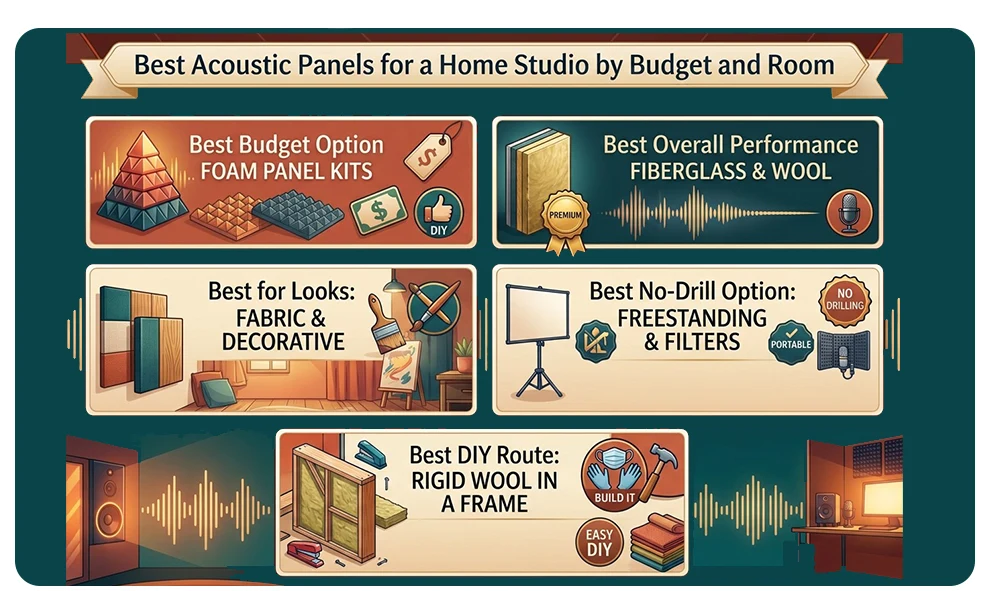
Best Budget Option: Foam Panel Kits
Foam kits are the lowest-cost starting point and are simple to install. For a room with only a little echo and a limited budget, a foam kit is a suitable size to start with. Just keep its limitation at low frequencies in mind.
Best Overall Performance: Fiberglass or Mineral Wool Panels
If performance matters more to you than price, fiberglass or mineral wool panels are the better choice because they absorb a broader range of sound. This category is better suited to a room where podcasts are recorded regularly. Also factor in their higher cost and weight.
Best for Looks (Living Room or Rented Space): Fabric-Wrapped & Decorative Panels
For a living room or a space where appearance matters, fabric or wooden panels are a suitable solution. These panels look like artwork or a decorative element. In a rented space, choose models whose installation doesn’t damage the wall.
Best No-Drill Option: Freestanding Absorbers & Reflection Filters
Freestanding absorbers and reflection filters are used without drilling and are easy to move around. If you record in different environments and need a portable podcast setup, this option is more suitable. Keep in mind, though, that a reflection filter reduces only part of the reflection around the microphone and is not a substitute for treating the whole room.
Best DIY Route: Rigid Mineral Wool in a Frame
For a DIY build, place rigid mineral wool inside a wooden frame and stretch breathable fabric over it. For the names and specifications of products such as Owens Corning 703 or Rockwool, be sure to use the manufacturer’s website. Wear a mask and gloves while working, and make sure the cover completely contains the fibers.
How Many Panels Do You Need and Where Do They Go?
The question of how many acoustic panels do I need has no fixed answer and depends on the room’s size, the amount of reflection, and your budget. Start with the key spots and, after listening to the result, add more if needed. If you want a specific number or coverage percentage, rely only on the manufacturer’s recommendation. Our complete podcast studio setup guide can also help you quite a bit. The general principle of acoustic panel placement for podcasting is to first cover the spots where sound from the speaker’s mouth hits and bounces back toward the microphone.
First Reflection Points & the Wall Behind the Host
First reflection points are spots on the wall where sound from the speaker’s mouth hits and bounces back to the microphone. A simple method is to have someone move a mirror along the wall until the speaker’s mouth is visible in the mirror from the microphone’s position; that spot is suitable for a panel. The wall behind the host usually matters too, because sound bounces from it back to the microphone.
Corners and Bass Traps
Corners are the right place for bass traps, because low-frequency energy gathers in them. If the room sounds “muffled” or boomy, check the corners among the first spots. Installing bass traps in corners usually comes after the panels at the reflection points.
Ceiling, Floor and Windows
Rugs, curtains, and furniture also reduce some of the reflection. A carpeted floor and a window covered with a thick curtain improve the room’s condition. Even so, these are not a substitute for panels and are only a complement to them.
Two Hosts or a Guest Chair
If you have two hosts or a guest, you need to consider the reflection points for each person separately, because where each person sits changes the reflection path. For a two-person layout, the guide on setting up a podcast setup for two hosts is useful. It’s also recommended that you prepare a top-down diagram of the room for planning the layout.
Soundproofing a Home Studio: What Actually Works
How to soundproof a podcast studio is a question whose honest answer is often disappointing: full soundproofing is expensive and can’t be achieved with simple home measures. But a few things do genuinely work and can reduce noise.
Seal the Gaps First
The first step is sealing the gaps, because sound passes through even the smallest cracks. A door sweep for the bottom of the door, acoustic sealant for seams, and covering vents are the cheapest and most effective place to start. Do this before any more expensive purchase.
Add Mass and Decouple
Adding mass, meaning MLV, an extra layer of drywall, or damping compound, can reduce sound transmission. But these methods require precise execution and usually don’t reach a complete result without changes to the structure. Their results can’t be promised with certainty either.
Doors and Windows
Doors and windows are the weakest points of a room, and the most sound passes through them. A solid, sealed door performs better than a hollow one. For windows, a thick curtain and sealing the edges help, although the effect is limited.
Manage AC and Appliance Noise
Turn off the split AC and other appliances during recording, or increase the microphone’s distance from them. HVAC / split AC noise is one of the most common constant noises in home recordings. Before recording, check the room once with that same voice memo to find the source of the noise.
Low-Cost Workarounds
If you can’t change the room, a portable vocal booth, blankets, or recording inside a closet are temporary solutions. These methods improve the room’s sound slightly, but they don’t guarantee a professional result. They are enough for occasional recordings, but for regular work you should think of a more lasting solution.
Setting Up a Home Studio in Dubai: Apartments, Villas and Heat
Buildings and climate in Dubai have a few particular points that should be considered when choosing a solution. Each type of property has its own limitations and possibilities.
Apartments and Shared Walls
In an apartment, shared walls are the biggest challenge. The topic of soundproofing a home studio in an apartment is genuinely limited, because changing the wall structure is usually not possible or not permitted. Focus on controlling the room’s interior and sealing the gaps.
Villas and Detached Rooms
In a villa or a detached room you have more options, and the distance from the neighbors is usually greater. Even so, sealing and adding mass are still important. Detached rooms may also have less outside noise.
AC Noise, Heat and Humidity
Intense heat and constant use of air conditioning make AC noise more prominent in recordings. Factor recording times and turning off the unit into your schedule. Also consider heat and humidity when choosing panels and where to keep them.
Rental-Friendly Options
If the property is rented, use no-drill options, because any permanent change may conflict with your lease. Coordinate with the landlord or building management before any change. Freestanding absorbers and removable panels are best suited to these conditions.
Common Acoustic Treatment Mistakes to Avoid
A few common mistakes are repeated when choosing and installing best acoustic panels podcast studio:
- Buying panels to solve an outside-noise problem
- Assuming foam on every wall makes the room “silent”
- Installing panels in the wrong place
- Ignoring the corners
- Choosing based on price without checking the specifications
Also, a diffuser is usually unnecessary in small rooms, and it’s better to get sound absorption right first.
Another mistake is evaluating microphone quality without considering the room. A bad room ruins even the best microphone. So it’s best to read our guide to the best podcast microphones before doing anything else.
When Your Room Isn’t Enough: Recording in a Treated Studio at Studio 321
Sometimes modifying a room to create a home studio isn’t justified: the room is small, outside noise is high, you’re not allowed to make changes, or the project needs higher quality. Also, buying best acoustic panels podcast studio comes with a significant cost. In these circumstances, recording in a professional studio makes more sense. Studio 321, a professional podcast studio in Dubai, located in Al Mamzar, offers this option, and you can book your recording time right now.
Frequently Asked Questions
Do acoustic panels soundproof a room?
No. Panels reduce reflections inside the room and do not stop sound from passing through the wall. To prevent sound from getting in, you need sealing, mass, and structural decoupling. If your main problem is outside noise, panels alone are not enough and you should also consider sealing.
How many acoustic panels do I need for a podcast room?
There is no fixed number. Start with the first reflection points and expand from there. If you need a specific number or coverage percentage, use only the manufacturer’s recommendation or their official calculator, and cite the source.
Is acoustic foam good enough for podcasting?
It is useful for controlling high and mid reflections, but it works to a limited degree at low frequencies. If you have a small budget, it’s a good start; for a more complete result, you should consider denser panels (see Section 2).
Can I make DIY acoustic panels?
Yes. Place rigid mineral wool in a frame and cover it with suitable fabric (see the “Best DIY Route” section). Wear a mask and gloves when working with fibers, and make sure the materials are fire-resistant and the cover is complete.
Can I record in a closet or use blankets instead of panels?
Yes, as a temporary solution. Hanging clothes inside a closet and blankets reduce reflections, but they have limits and no reliable result is promised. If you record regularly, move gradually toward real panels.
Can I install acoustic panels in a rented apartment in Dubai?
It depends on your lease and the permission of the landlord or building management. Coordinate with them before any installation. If there are restrictions, consider no-drill options such as freestanding absorbers or a reflection filter.