
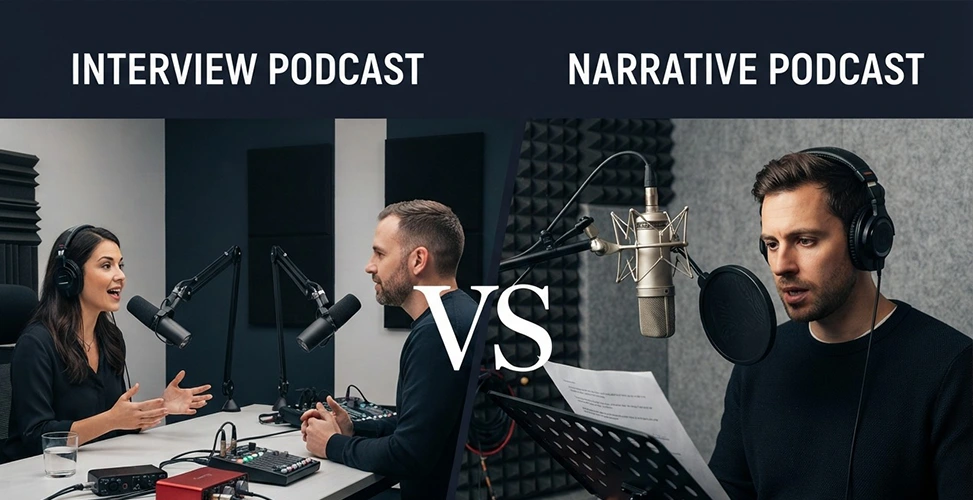
Anyone who decides to make a podcast faces an important question before buying a microphone and choosing software: should you have a conversation with a guest, or narrate a story yourself? This article is written for exactly this stage and compares the interview vs narrative podcast format head to head. The goal is not to pick a winner between the two. The goal is to clarify the differences in planning, recording, editing, release rhythm, and budget, so readers can choose the format that fits their own time and skills and better understand narrative vs interview podcast.
The Main Differences of interview vs narrative podcast format in Under a Minute
| Criteria | Interview | Narrative |
| Nature of the format | conversational format | Based on storytelling |
| Focus of the show | The guest | The host and their story |
| Host’s role | Asking questions | Telling the story with scripted narration |
| Editing | Usually light | Meticulous, with voice-over |
| Source of episode value | The conversation | The structure the producer has designed for the story |
| Listener experience | Being present in a real conversation | Hearing a pre-designed story |
The number of hosts is a decision separate from the choice of format, and it is covered separately in the solo vs co-hosted podcast guide.
interview podcast pros and cons
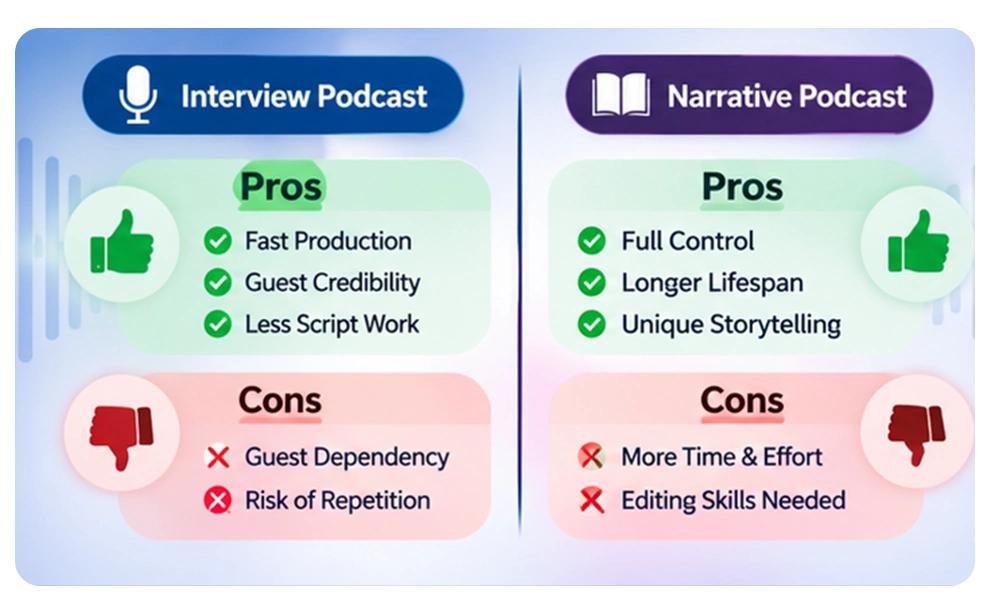
At a glance, the most important advantages of an interview podcast are speed and flexibility. It also has other pros and cons, which we cover below:
Pros
- A complete episode can be made in a short time with one good conversation.
- Guests bring their own credibility and audience to your podcast, and the show grows faster this way.
- This format reduces the pressure of writing scripts and content, because the guest creates a large part of the content.
Cons
- The weakness of this format is its dependence on the guest. If the guest is not talkative or the recording time changes, the quality of the episode suffers directly.
- Finding suitable guests also becomes a heavy task over time.
- On the other hand, because the structure of the episodes is similar, shows that don’t have fresh guests and perspectives quickly start to feel repetitive.
narrative podcast pros and cons
Reviewing the advantages of this format is also essential for the interview vs narrative podcast format comparison, and they are as follows.
Pros
- The biggest advantage is complete control. You decide what the listener hears and when.
- Episodes have a longer lifespan, because the story doesn’t depend on the release date.
- This format is also suitable for branding and differentiation, because building a coherent story arc is not something everyone can do.
Cons
- The price of having complete control over the podcast is time and skill. Research, writing, recording, editing, and voice-over are each a separate stage, and a single episode may take weeks.
- If the script is weak, even good editing can’t save it. For this reason, many beginner creators get exhausted halfway through.
Workload, Release Rhythm, and Budget
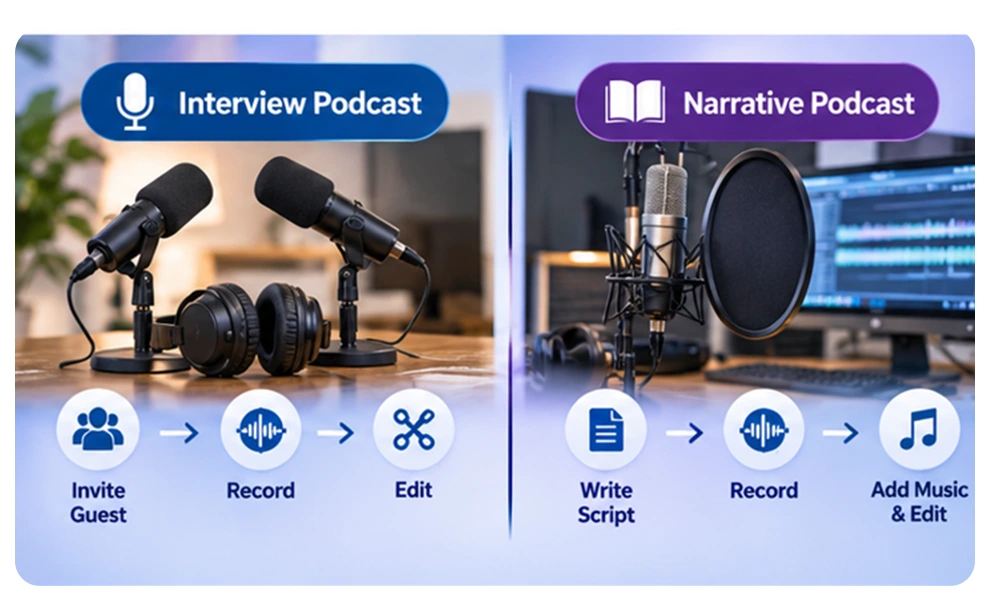
In terms of production workload, Interview is lighter. Recording is usually a single session, editing is mostly limited to removing pauses and adjusting audio, and a regular weekly release is achievable. Narrative has several times the workload, so the release rhythm is slower as well. In this format, releases are usually planned as seasons: a full season is produced and then published. The choice between serialized vs episodic also depends on this. Interview is often episodic, and each episode can be listened to independently, while Narrative mostly needs connected, chained episodes.
Budget follows the same logic. The cost of Interview is mostly spent on clean recording, and the cost of Narrative is spent on editing and voice-over time. If you have limited budget and time, the difference between these two is usually decisive in choosing between the interview vs narrative podcast format.
Interview Podcast Setup: Recording a Conversation with a Guest
- The minimum this format requires is a separate microphone for each person and a quiet environment.
- The conversation should be planned in advance.
- A short pre-interview with the guest lets you know what they are most comfortable talking about.
- Then a question list is prepared. Of course, this list should be a guide, and you shouldn’t use it like a screenplay.
- If the guest is in another city, a remote interview is needed. In this case, double-ender recording, meaning recording each person’s audio separately on their own device and combining them later, prevents quality loss caused by internet issues.
- Choosing recording software podcast tools also depends on your circumstances, and you should give it enough attention.
Narrative Podcast Setup: From Script to Voice-Over
- This format starts with writing, not recording.
- Usually the episode begins with a cold open, meaning a short, engaging scene before the show’s introduction.
- Then the story moves forward following a story arc.
- The narration should be recorded in a very quiet space so that editing is easier later and the
- host’s voice stays consistent across all episodes. Good voice-over is even more important than the script in this format.
In the narrative podcast setup, the equipment is simpler than for Interview, but the editing is more complex. Narrative podcast equipment usually includes a good microphone, closed-back headphones, and an acoustically treated space, followed by more powerful editing software. For this reason, you should use the best podcast editing software, and the rest of the work is about layering audio:
- sound design and music bed, which create the sense of a scene.
- field recording, which brings real-world atmosphere into the story.
- archival audio, which lends credibility to the podcast.
Combining the Two Formats: Hybrid Format
Interview Podcast vs Narrative Podcast doesn’t mean you must choose one of the two. In a hybrid format, the host records conversations and then edits and narrates them like a story. This creates a narrative interview:
the guests’ voices are the raw material, and the host’s narration connects them. Many shows start with Interview and, after becoming familiar with editing, add narrative episodes too. Therefore, changing formats in the future is possible, and today’s choice is not irreversible. You just need to know that the two have different needs at the beginning. If you are worried about finding guests, the booking podcast guests guide will be useful to you.
How Do We Choose the Right Format?
If after Interview Podcast vs Narrative Podcast you still don’t know which is better for you, five simple questions help with the decision:
- What is your goal?
If it is fast growth and connecting with important people in the industry, Interview is more suitable.
If it is creating a lasting work and a strong brand, Narrative. - How much time do you have?
If you want one episode per week, Interview.
If monthly or seasonal, Narrative. - What is your budget?
For Interview, invest in clean recording.
For Narrative, invest in editing. - Do you have access to guests? If not, Narrative is possible without depending on others.
- How strong are your writing and editing skills? If they are limited, start with Interview.
If you are still at the beginning of the path, our complete guide to How to start a podcast in Dubai gives you a fuller picture of the next steps and makes the decision easier. Overall, the answer is hidden in these five questions: the format that matches your time, budget, and skills is the right format.
Final Thoughts: Starting with a Clean Recording
Both formats start from the same point: clean audio. In Interview, this means a multi-microphone conversation with noise control and the right distance from the microphone. In Narrative, it means recording the narration in a quiet, echo-free space. Understanding the differences in interview vs narrative podcast format can help you choose the approach that best suits your content and storytelling goals. Overall, remember that editing cannot fully make up for low recording quality. Once you have chosen your format, it’s best to do your first recording in a ready, professional environment by choosing to book a session at our Dubai podcast studio.
Frequently Asked Questions
Which is easier to start: an interview podcast or a narrative podcast?
Interview is usually lighter to start, because it has no script or voice-over, and one recording session can become a complete episode. However, this ease depends on finding a suitable guest and on your skill in steering the conversation.
Can an interview podcast also tell a story?
Yes. An interview-based show can build a coherent story by carefully selecting and arranging conversations and adding the host’s narration between them. This is a hybrid approach that treats the guests’ voices as the raw material of the narrative.
Do narrative podcasts need more expensive equipment?
Not necessarily. The baseline recording quality is the same in both formats: a suitable microphone and a quiet space. The main cost of Narrative is the time spent on writing and editing rather than buying equipment. If your budget is limited, plan first for clean recording and then for the time needed for editing.
Do I need a studio to record an interview or narrative podcast?
No, but a controlled space usually improves sound quality, because there is less noise and echo and editing becomes simpler. You can start with simple equipment in a quiet environment and use a studio later if needed.
Is an interview or narrative podcast better for a business?
The answer depends on the brand’s goal. If connecting with influential people in the industry and producing content regularly matters, Interview may be more suitable. If the goal is to build a lasting narrative about the brand, Narrative is the better choice.
Can I switch from one format to the other later?
Yes. It’s best to change formats at the start of a new season and to inform listeners beforehand so they aren’t taken by surprise. Many shows start with Interview and add narrative episodes after mastering editing. A gradual change is usually less risky.