
If you’ve been publishing your podcast for a while but audience growth is slower than you expected, the problem isn’t necessarily your content quality; sometimes the issue is that you still don’t have a clear podcast cross promotion strategy for introducing your show to new listeners. Learning how to put together such a strategy is, in fact, the answer to the common question of how to cross promote a podcast; and the good news is that with a bit of planning, you can largely grow podcast audience for free, without needing an advertising budget.
In this guide, you’ll get familiar with the different types of Cross-Promotion, including podcast guest swap, podcast promo swap, and trailer swap podcast, and you’ll learn how to find the right partner, pitch a collaboration, track the results, and avoid common mistakes. This article is part of a broader collection on podcast growth strategies, which we covered in our podcast marketing strategy article.
What Is Podcast Cross-Promotion (and Guest Swaps)?
Every successful podcast cross promotion strategy requires collaboration between two or more podcasts, in which each one encourages its audience to listen to the other’s show. This introduction can take the form of a short audio ad at the start of an episode, a trailer exchange, or even a joint appearance on an episode.
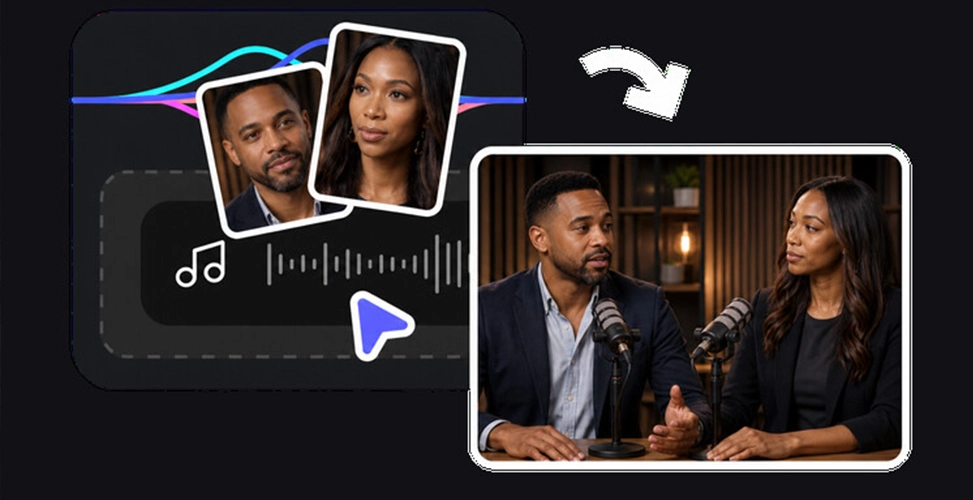
A podcast guest swap is exactly this kind of joint appearance: two podcast hosts each appear as a guest on the other’s episode. Since both sides actively participate in producing the content, this method usually builds more engagement and trust than a simple ad, which is why it’s considered the core of many forms of podcast partnership marketing.
It’s important to note that Cross-Promotion is fundamentally different from paid podcast advertising; no money changes hands here — instead, the basis of the collaboration is an equal exchange of value between two shows.
Why Cross-Promotion Works for Podcast Growth
Much of the success of any podcast cross promotion strategy comes down to two very important points:
- First: a listener introduced by another podcast already has some initial trust in the new show, because the introduction comes through someone they already trust, not through a generic ad. This kind of intermediary trust means the conversion rate from new listener to loyal listener is far higher than with regular advertising.
- Second: when two podcasts have audiences with similar interests but aren’t necessarily direct competitors, both sides benefit without competing head-on for the same listeners; this is the logic behind most forms of podcast partnership marketing.
This strategy is one of the few growth methods that can genuinely grow podcast audience for free, requiring only time and coordination rather than budget; that’s why it’s a realistic option for small, newer shows too. Over time, taking part in several successful collaborations can effectively make you part of an informal podcast network of shows in the same niche.

The Main Types of Podcast Cross-Promotion
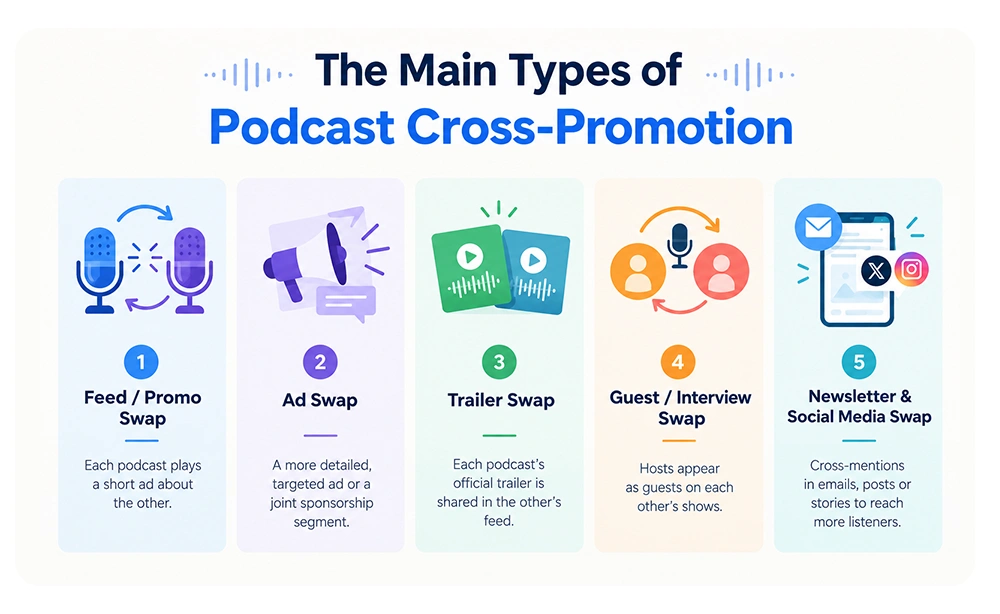
Before starting any collaboration, it’s worth knowing which form of Cross-Promotion fits your goal, since choosing the right format is a key part of any effective podcast cross promotion strategy.
Feed / Promo Swap
In this method, also called a feed swap, each podcast plays a short audio ad (usually 30 to 60 seconds) about the other podcast in one of its episodes. This is the simplest kind of podcast promo swap and doesn’t require complex scheduling.
Ad Swap
This is similar to a promo swap, except the ad content is usually more detailed and targeted, sometimes even taking the form of a short mutual sponsorship segment between the two podcasts.
Trailer Swap
In this case, each podcast’s official trailer is published in the other podcast’s feed. This kind of trailer swap podcast is more common for newly launched shows, since it gives listeners a full picture of the new podcast’s vibe.
Guest / Interview Swap
As mentioned earlier, in an interview swap, hosts appear as guests on each other’s podcasts. This form of collaboration usually creates the deepest connection with a new audience and often results in a full episode swap between the two shows.
Newsletter & Social Media Swap
Collaboration can go beyond the podcast itself; for example, a cross-mention in an email newsletter or a social media story and post, which is especially effective for amplifying the results of a Guest Swap.
How to Find the Right Cross-Promotion Partners
Finding the right partner is the most important step in executing any podcast cross promotion strategy. To do this, you should consider the three criteria below:
Audience Overlap Without Direct Competition
Look for podcasts whose audience has audience overlap with your target audience, but whose main topic isn’t the same. For example, a podcast about entrepreneurship and a podcast about personal productivity share a lot of common audience without being direct competitors.
Similar Show Size
Collaboration tends to work better and more evenly when both podcasts have a similar listener count. A very large podcast usually has less incentive to swap with a much smaller show, unless the content is genuinely valuable to them.
Content & Tone Fit
Even if the two shows’ topics aren’t exactly the same, the tone and style of delivery should be compatible; a comedy podcast and a strictly academic podcast, even with a shared audience, create a jarring experience for listeners. To learn from shows that pick the right guests for their episodes, reading the how to booking podcast guests guide can also be helpful.
How to Pitch a Guest Swap or Cross-Promotion
After identifying a potential partner, how you pitch the collaboration matters a great deal; in fact, this step is the practical answer to the question of how to cross promote a podcast. To do this, you should:
- Your initial outreach message should be short, personalized, and specific; mention that you’ve listened to several episodes of their podcast and exactly why you think the collaboration would benefit both sides.
- It’s best to clearly specify the type of collaboration you’re proposing from the start (for example, a Guest Swap or just a mutual ad), and if you can, suggest a rough timeframe as well.
- Podcasters usually have tight publishing schedules, so the more specific and low-hassle your pitch is, the higher the chance of a positive response. Avoid generic, copy-pasted messages that are clearly sent to dozens of other podcasts as well; these kinds of messages usually go unanswered.
How to Structure and Track a Swap
Running a smooth Cross-Promotion swap comes down to three practical steps: setting clear expectations upfront, tracking results as they come in, and reviewing performance once the dust settles.
Setting Clear Expectations
Before recording or publishing any content, clarify the details: the length of the ad or episode, the approximate publish date for each side, and whether the content needs final approval from the other party. Not having a clear agreement is the most common reason collaborations fall apart, and it can undermine even the best podcast cross promotion strategy.
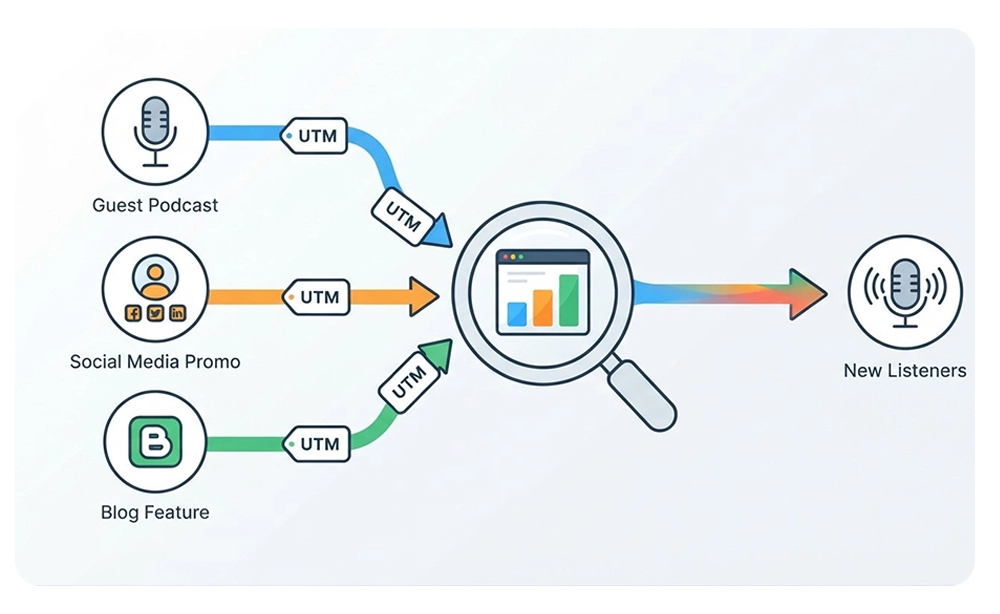
Using UTM Links to Measure Results
To really know how effective the collaboration was, use dedicated UTM links for each partner. These links let you pinpoint exactly how much traffic or how many new listeners came to your podcast through each specific collaboration.
Reviewing Performance After the Swap
A few weeks after publishing, check your podcast analytics data and see whether you got a noticeable increase in downloads or shares. This review helps you decide whether it’s worth repeating the collaboration with the same partner or trying a similar approach with other partners; if monetization is one of your goals, the how to make money from a podcast guide can complement this step nicely.
Common Mistakes to Avoid
- One of the most common mistakes is choosing a partner purely based on audience size, without considering topical fit; the result of such collaborations is usually listeners who quickly drop off.
- Another mistake is not having a clear timeline in place, which causes the swap content to be delayed or forgotten altogether.
- Neglecting to track the results of a collaboration is also one of the most common weaknesses in any podcast cross promotion strategy. Without accurate data, it’s nearly impossible to tell which type of collaboration was actually effective.
- Finally, neglecting cross-promotion on social media also limits the opportunity; even a successful swap in a podcast feed will have less impact if it isn’t reinforced with a post or a story.
Recording a Guest Swap Episode the Right Way
When it comes time to actually record a Guest Swap, technical sound and video quality matter just as much as the content itself, since this episode is meant to introduce your podcast to a completely new audience. Recording in a professional studio eliminates issues like poor audio quality, echo, or dropped connections that are common with remote or home recording; in fact, this is the stage where a good strategy truly turns into a high-quality co-produced episode.
If you’re planning to record such a joint episode at high quality without technical hassles, you can book the professional S321 podcast studio in Dubai for this. For episodes that will also be released as video, S321’s video podcast production dubai service is a great option too, so both audio and video are captured to the same standard.

Final Thoughts
Ultimately, none of these methods work miracles on their own; what truly makes audience growth sustainable is having a cohesive podcast cross promotion strategy that fits your show’s real goal and audience, is executed consistently, and has its results properly tracked.
The best results usually come from repetition and consistency, not a one-off collaboration; the more partners you exchange with over time, the stronger your cross-referral network becomes. If you take one small step today and plan your first Cross-Promotion, you could see its real impact on your listener numbers within a few weeks.
Frequently Asked Questions
What’s the difference between a Guest Swap and a Promo Swap?
In a Guest Swap, two hosts actually appear on each other’s episodes and produce shared content together; but in a Promo Swap, it’s just a short audio ad about the other podcast played during the episode, with no direct appearance from the other host.
How do I find podcasters who are open to Cross-Promotion?
Searching platforms that list podcasts in the same niche, joining online podcaster groups and communities, and checking episodes where hosts have already done a Guest Swap themselves are all effective ways to find the right partner.
Does this method really work for small or newer shows?
Yes, as long as the right partner is chosen. Smaller shows usually have a better chance of collaborating with shows of a similar size, and these small collaborations can lay the foundation for sustainable growth; even without an advertising budget, you can gradually attract a new audience this way.
Should I use UTM links to track results?
Yes — without these links, you really can’t tell which collaboration actually increased your listenership and which had little effect.
Can I do a Swap with a podcast that’s much bigger than mine?
It’s possible, but the chance of success is lower unless you have something genuinely valuable to offer them — such as unique expertise or a very targeted audience — that would appeal to them.