

After building a podcast, it’s undoubtedly exciting to see numbers like follower count, download count, and so on — what are known as podcast analytics metrics. It’s to see these very numbers that many podcasters check their analytics dashboard every day, but sometimes they’re chasing the wrong number. Focusing solely on downloads or follower count gives a person an incomplete and sometimes misleading picture of a podcast’s growth. In fact, these figures are what’s known in the world of analytics as Vanity Metrics — numbers that look good but on their own don’t indicate growth, audience engagement, or a podcast’s readiness to attract sponsors. For any podcaster who wants to make decisions about their show based on data, understanding these distinctions precisely is the starting point of the story and of making money from a podcast.
Podcast Analytics Metrics: Key Indicators for Analyzing Podcast Performance
Why Most Podcasters Are Tracking the Wrong Numbers
- Focusing on download count instead of audience retention rate (Retention): A high download count doesn’t necessarily mean the episode was heard in full; many listeners drop off after the first few minutes.
- Ignoring the drop-off point (Drop-off Point): Not knowing exactly which minute of the episode the audience exits at means the real content problem (a long intro, a slow pace, etc.) never gets identified.
- Overvaluing follower or subscriber count: One of the podcast analytics metrics is follower count. However, following doesn’t indicate commitment; many podcasts that are successful in terms of revenue and impact have few followers but a large loyal audience.
- Comparing against chart rankings (Chart Rankings): Ranking on Apple or Spotify charts is usually temporary and algorithm-dependent, not a reliable measure of long-term growth or content quality.
- Neglecting the listener-to-customer/member conversion rate (Conversion Rate): For podcasts with a commercial goal, the number of listeners who actually take action (purchase, sign up, click a link) matters more than the overall listener volume.
- Disregarding engagement quality (Engagement Quality): The number of comments, shares, and direct messages from listeners is a better measure of real audience connection than simply counting plays or downloads.
- Measuring short-term growth instead of the long-term trend: Weekly download fluctuations can be misleading; a three-to-six-month trend gives a truer picture of a podcast’s growth.
- Ignoring traffic source (Traffic Source): Not knowing where listeners are coming from (search, social media, others’ recommendations) means the marketing strategy can’t be targeted properly.
Downloads, Listens, and Unique Listeners: What’s the Difference?
One of the most common mistakes podcasters make is confusing two concepts among podcast analytics metrics — downloads and unique listeners:
downloads refers to the number of times an episode file has been received from the hosting server; this number can include automatic app downloads, repeat downloads by the same user, or even bot requests.
By contrast, unique listeners attempts to provide a more accurate estimate of the number of actual people, usually by filtering out IP addresses and repeat requests within a defined time window.
Alongside these two concepts, there’s also a third metric called listens, which again differs from both downloads and unique listeners:
listens refers to the number of times the episode file was actually played — meaning the user clicked play and listened to part of the content; unlike downloads, which simply shows the file was received from the server, even if it’s never played. Some platforms set a threshold for registering a listen, such as playing at least a few seconds or a percentage of the episode; for this reason, this number is usually lower than downloads.
The difference between listens and unique listeners lies here too: listens shows the total number of play instances (one person can listen to an episode multiple times), while unique listeners estimates the number of distinct individuals who listened at least once.
The 5 Podcast Metrics That Actually Matter
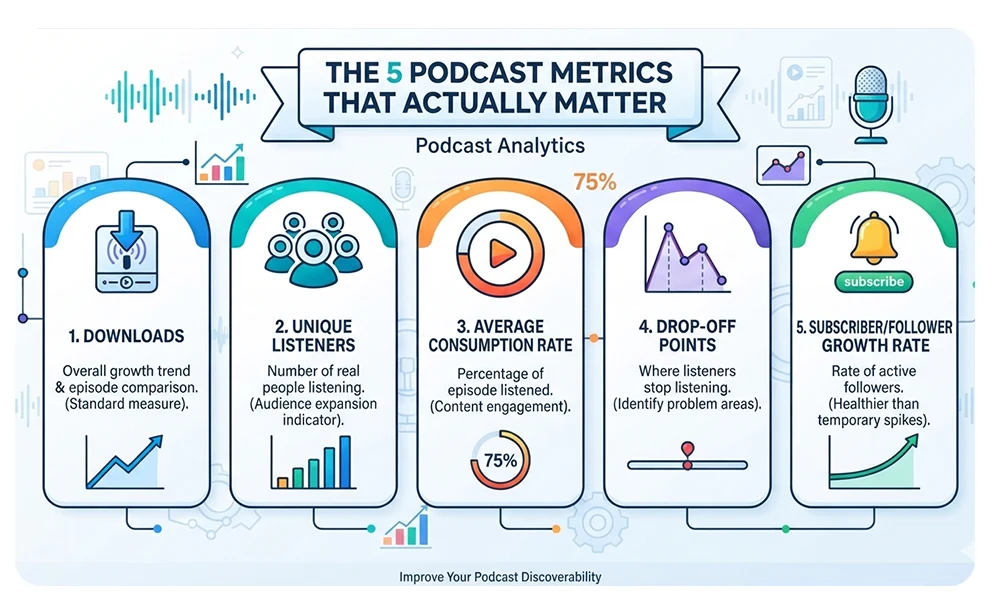
If you’re looking to improve your podcast’s discoverability, you need to pay attention to the following 5 important metrics among podcast analytics metrics, especially when working on Podcast SEO:
Downloads
Despite the limitations mentioned for this indicator, it remains a standard measure for comparing the overall growth trend of a podcast over time, especially when comparing different episodes over a similar window (for example, the first seven days after release).
Unique Listeners
This number shows how many real people have listened to your content. Steady growth in unique listeners is usually a more reliable sign of genuine audience expansion than growth in downloads.
Average Consumption Rate (Listen-Through Rate)
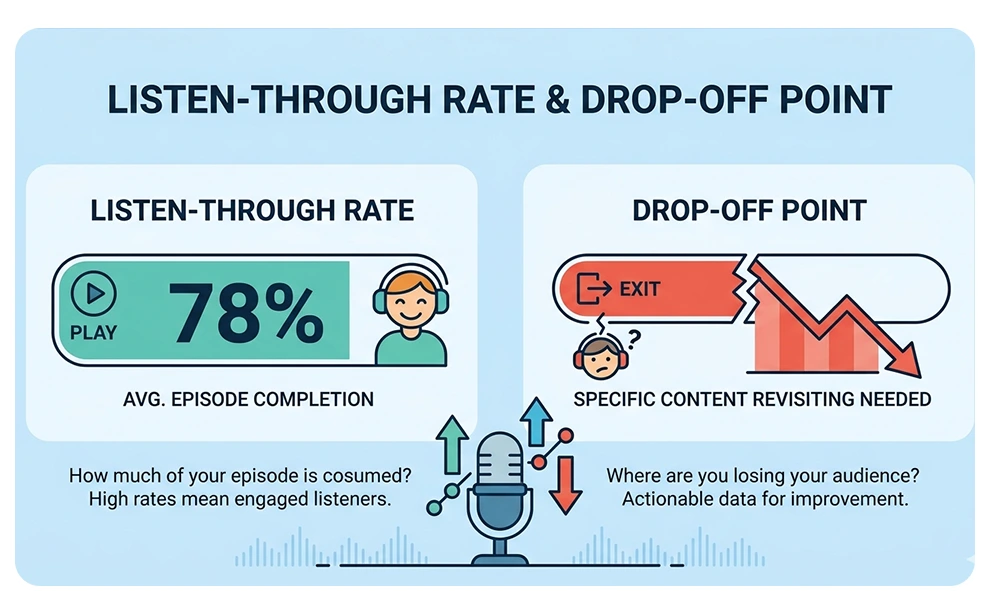
This metric, sometimes called average consumption rate and sometimes listen-through rate, shows what percentage of an episode listeners consume on average. If this number is low, even with high downloads, there’s a problem with the episode’s length, content quality, or editing pace.
Drop-Off Points
Drop-off data shows exactly which minute of the episode a significant portion of listeners abandon it. This is one of the most actionable pieces of data you can have, because it tells you directly which part of the content or editing needs revisiting.
Subscriber/Follower Growth Rate
This metric shows the growth rate of the number of people actively following your podcast so they don’t miss new episodes. Steady growth in this number, even at a slow pace, is usually a healthier sign than a temporary spike in downloads.
Using these five metrics together precisely is a natural prerequisite for any step in a podcast marketing strategy; if you don’t yet have a broader roadmap for growing your podcast, you can use our complete podcast marketing strategy guide to put this data to more precise use in your planning.
What Counts as “Good” Analytics? Realistic Benchmarks
What counts as “good” for podcast analytics metrics is relative and depends on the goal, the topic niche, and the audience size; a number that’s excellent for a brand-new podcast may not be good for a podcast with several years of history.
Benchmarks for New Shows (0–10 Episodes)
At this stage, constantly checking podcast analytics metrics and expecting high downloads isn’t realistic. What matters more is relative consistency in the numbers from episode to episode and an acceptable listen-through rate (usually above 40 to 50 percent for shorter episodes). Of course, sharp fluctuation in this range is natural and shouldn’t be a cause for concern, since you’re still at the very start of the road.
Benchmarks for Established Shows
For podcasts that have reached a stable audience, the main focus should be on the long-term trend of subscriber/follower growth rate and the consistency of completion rate across different seasons, rather than just one or two standout episodes.
Best Tools for Tracking Your Podcast’s Analytics
Several tools can be used to check podcast analytics metrics, the most important of which are:
Built-in platform tools
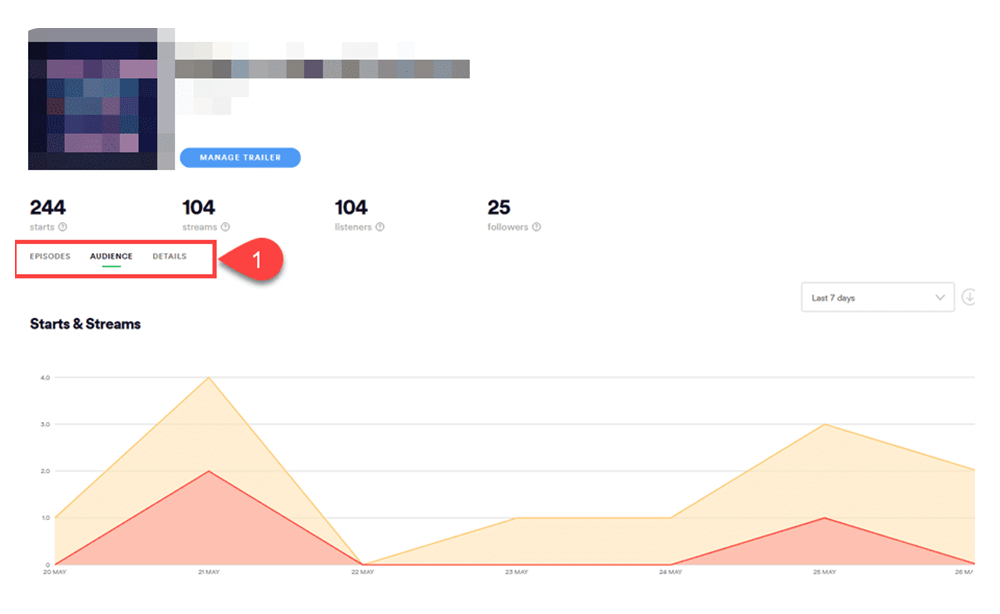
Spotify for Podcasters and Apple Podcasts Connect are useful because they’re free and pull data directly from the platforms real listeners are actually on. The main limitation of these tools is that their picture is limited to that one platform.
Third-party and hosting analytics
Tools like Chartable, Podtrac, and Buzzsprout offer a more unified picture of episode performance across all platforms via the RSS feed, and are nearly essential for podcasters who publish their show across multiple platforms.
Why IAB Certified matters for sponsors
Many serious sponsors, especially larger brands, want statistics that have been verified by an IAB Certified tool before closing a deal. This certification guarantees that your numbers have been calculated according to an industry standard, not by some arbitrary method that might inflate the numbers beyond reality.
Turning Your Numbers Into Better Decisions (and Sponsor Conversations)
Being aware of podcast analytics metrics and continuously tracking certain figures and statistics ultimately serves one big goal: being heard and generating revenue. The following will help you reach that goal.
Using drop-off data to fix weak episodes
When you see a large portion of listeners abandoning an episode at exactly one specific point, listen closely to that point. Sometimes the problem is a long intro, sometimes an ill-fitting ad break, and sometimes a drop in conversational pace. Fixing these exact points over several consecutive episodes usually has a noticeable effect on the show’s overall average consumption rate.
What sponsors actually want to see
Sponsors are usually less concerned with raw downloads than with listen-through rate, the stability of subscriber growth, and the availability of IAB Certified statistics. Having this data ready and organized shortens the path to attracting the right sponsors for your show. Of course, the details of pricing and the various models for monetizing a podcast are a separate discussion.
Final word
In the end, tracking podcast analytics metrics only shows its full value when episode production is of a quality from the start that’s capable of improving these numbers — something you can achieve with book a session at our Dubai podcast studio at Studio 321, from recording all the way to final mixing.
In the end, tracking podcast analytics metrics only shows its full value when episode production is of a quality from the start that’s capable of improving these numbers — something you can achieve when you book a session at our Dubai Podcast Studio at Studio 321, from recording all the way to final mixing.
Frequently Asked Questions about podcast analytics metrics
Is there a good number for downloads for a new podcast?
In the first few weeks, most new shows start with very small numbers, and that’s completely normal. More important than the number itself is the growth trend from episode to episode and the stability of the listen-through rate.
Is downloads the same thing as what’s called listens?
Not exactly. downloads refers to the file being received from the server, while a “listen” usually means the user actually played part of the file. Some platforms report these two separately and some don’t.
What listen-through rate is considered “good”?
It varies depending on episode length, but for many podcasts, a number above 60 to 70 percent is a good sign of strong audience engagement.
If I publish on multiple platforms, which analytics tool should I use?
It’s best to use a third-party, RSS feed–based tool like Chartable or Podtrac alongside built-in tools like Spotify for Podcasters, so you get a unified picture across all platforms.
Do I necessarily need IAB Certified analytics before working with sponsors?
Not necessarily for every sponsor, but for larger brands and more serious deals, having IAB Certified statistics is usually a practical prerequisite.
How often should I actually check my podcast’s analytics?
Checking weekly is enough to track the overall trend; obsessive daily checking usually adds nothing but extra stress, except right after releasing an important episode.