

If you’re a serious podcast listener, or you’ve decided to build a podcast of your own, you undoubtedly know there are two types of podcasts in terms of execution: Solo podcast and Co-Hosted podcast. Choosing between them affects your recording schedule, the amount of equipment needed, your editing workload, and the type of connection you build with your audience. Neither of these two formats is absolutely better than the other, and the choice depends on your personality, your content goals, your available time, and your ability to publish consistently. If you’re planning to launch your first podcast, Solo vs Co-Hosted Podcast will help you make a more informed decision before buying equipment or booking a recording session.
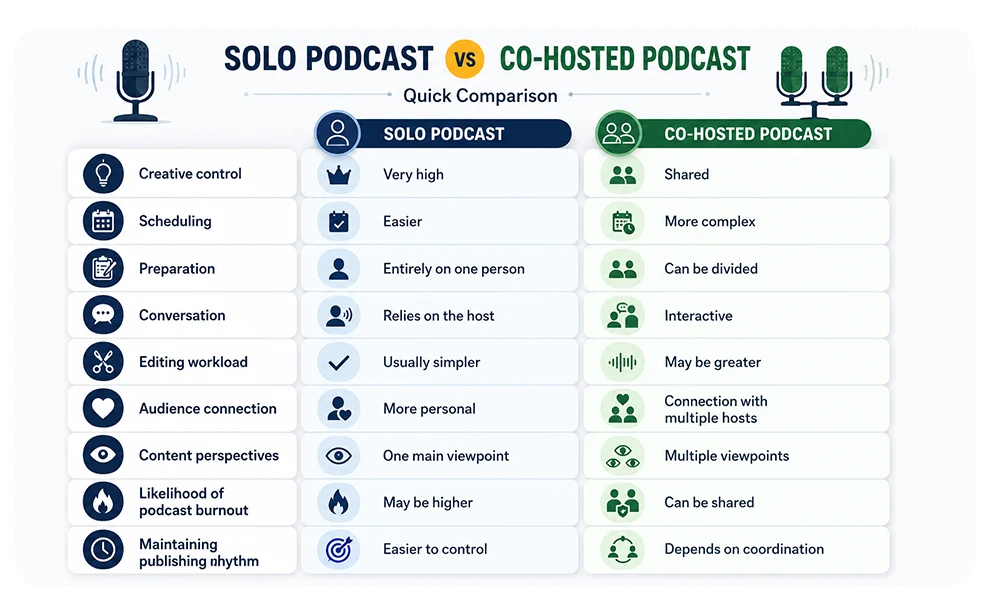
Quick Comparison Solo vs Co-Hosted Podcast
| Criterion | Solo Podcast | Co-Hosted Podcast |
| Creative control | Very high | Shared |
| Scheduling | Easier | More complex |
| Preparation | Entirely on one person | Can be divided |
| Conversation | Relies on the host | Interactive |
| Editing workload | Usually simpler | May be greater |
| Audience connection | More personal | Connection with multiple hosts |
| Content perspectives | One main viewpoint | Multiple viewpoints |
| Likelihood of podcast burnout | May be higher | Can be shared |
| Maintaining publishing rhythm | Easier to control | Depends on coordination |
What Is a Solo Podcast?
In a Solo podcast, only one main host is responsible for running the episode. The host introduces the topic, drives the discussion forward, and is usually the main point of connection with the audience as well.
The most important advantage of this format is complete control over the podcast. You decide on the topics, the recording time, the episode length, and the presentation style, and you don’t need to coordinate your schedule with anyone else.
This format can be a good choice for educational podcasts, personal brands, analytical shows, specialized podcasts, and content delivered by a single expert.
Of course, the entire responsibility for creating an engaging episode also falls on you. You need to be able to carry the conversation on your own, prepare enough content, and hold the audience’s attention without help from another speaker. For beginners, this can be somewhat difficult at first. With practice, Solo podcasting can become one of the simplest formats to manage.

What Is a Co-Hosted Podcast?
In this section of the solo vs co-hosted podcast article, it’s time for the other execution model: in a Co-Hosted podcast, two or more hosts are permanently responsible for producing and running the episodes.
In this model, instead of one person managing the entire conversation, the hosts can react to each other’s comments, ask questions, tell stories, and offer different points of view.
This very interaction is one of the most important appeals of this format. Good podcast chemistry can make an episode feel more like a natural conversation than a pre-written script.
This format is a good option for conversation, entertainment, analysis, news, storytelling, and topics where presenting multiple viewpoints is valuable.
On the other hand, more coordination is required. The hosts need compatible personalities, good communication with one another, and agreement on the show’s overall direction. Scheduling recordings can also become more complicated, since the recording time depends on the availability of multiple people.

Solo Podcasting: Pros and Cons
Every podcast format, whether run by one person or by two or more, has its own specific advantages and disadvantages. Being aware of these helps in answering the question Solo vs Co-Hosted Podcast: which format is better?
Advantages of Solo Podcast
- Complete creative control: you decide on the topic, recording time, structure, and presentation style of the episode.
- Simpler scheduling: you only need to manage your own time. This makes it easier to maintain a consistent publishing rhythm.
- Less need for coordination: you don’t need to factor in another person’s time, readiness, or preferences into the production schedule, and even podcast naming is entirely your own decision.
- Stronger personal branding: a single-host podcast can establish you as the main voice and central character of the show.
- More flexibility in recording: you can record shorter segments, redo parts, or add new content to the episode.
Disadvantages of Solo Podcast
- The biggest challenge is keeping the episode engaging without another voice present.
- The entire burden of preparation also falls on you. Research, writing, delivery, connecting different segments, and maintaining audience engagement all depend on you.
- You may gradually experience podcast burnout, since you feel you have to handle every creative and executive stage of the podcast alone.
- In Solo podcasting, careful preparation is also more important. When there’s no other host to ask questions, you need a clear structure to prevent repetition, long pauses, and, of course, the audience losing interest.
Co-Hosted Podcasting: Pros and Cons
In this section of the Solo vs Co-Hosted Podcast article, it’s time to look at the strengths and weaknesses of the other podcast format.
Advantages of Co-Hosted Podcast
- More natural conversation: two well-matched hosts can create a dynamic and engaging conversation.
- Division of responsibility: various tasks such as researching the discussion topic, preparing the flow of the conversation or guest questions, hosting, and part of the production duties can be split between the hosts.
- Presenting different viewpoints: differing perspectives between two or more hosts can make discussions of complex topics more engaging.
- Different connection with the audience: listeners may connect with both hosts and become interested in different personalities on the show.
- More engaging content: questions, reactions, jokes, and disagreements can create moments that are harder to produce in a single-host podcast.
Disadvantages of Co-Hosted Podcast
- A multi-host podcast requires more coordination.
- Scheduling conflicts can disrupt the publishing rhythm. Even if both hosts are committed to the schedule, work, travel, or personal responsibilities may make regular recording difficult.
- Disagreements over topics, episode structure, branding, or the show’s future direction can also become a challenge.
- The matter of podcast chemistry is also very important. Two people might each be good hosts individually, but be unable to have an engaging conversation together.
- Good hosts don’t necessarily always agree with each other. They need to be able to disagree on various topics without turning every episode into an argument.
6 Key Factors to Consider Before You Choose
To choose the right option between Solo vs Co-Hosted Podcast, you need to examine how well each model fits your actual circumstances.
1.Time & Preparation Workload
First, ask yourself how much real time you have for the podcast each week. A single-host show may require more individual preparation. You have to research, organize the content, deliver it, and review the final result yourself.
In a multi-host show, part of the preparation can be divided among the people involved. However, coordination and planning sessions can add more time to the production process. Don’t assume that having two hosts automatically means the work is cut in half.
2.Chemistry & Conversation Flow
For a multi-host show, coordination between the people involved matters a great deal. Before choosing this format and committing to it, record a few trial conversations. Then listen to the result without judging the people’s personalities.
- Do the hosts naturally build on each other’s comments?
- Are the pauses acceptable?
- Does one person talk too much?
- Does the conversation flow smoothly?
These questions are far more useful than simply asking whether both hosts are good speakers.
3.Content Consistency & Publishing Rhythm
Consistency is one of the most important practical factors in podcast production. If you want to publish an episode every week, check whether everyone involved can actually stick to that schedule.
A solo host usually faces fewer external obstacles to recording. A multi-host show, on the other hand, depends on the free time of several people. If maintaining a consistent publishing rhythm is your top priority, the single-host format may have an advantage.
4.Scheduling & Coordination
To compare Solo vs Co-Hosted Podcast before choosing a format, you need to review your work calendar.
A two-host podcast requires shared time for recording. As more people are added, scheduling becomes even more difficult.
You should also determine from the start what will happen if one of the hosts can’t be present for a recording.
Having a backup plan can prevent production from stalling due to one person’s absence.
5.Editing & Production Effort
The number of voices can affect the editing workload.
A two-host episode may require more attention to balancing volume levels, overlapping speech, gaps between words, pauses, and hosts talking at the same time. That said, today’s equipment and recording processes can make multi-host production much simpler. Using the right microphone and a standard recording environment can also reduce editing issues from the very start.
Also, our guide to podcast setup for two can help you reduce these obstacles significantly.
6.Audience Connection Style
Think about what kind of experience you want your audience to have with your podcast. A single-host podcast can create a direct relationship between the host and the audience. Listeners may feel they’re hearing the experience or expertise of one specific person. A multi-host podcast can feel more like listening to a conversation between two friends.
Neither of these two approaches is inherently more engaging. The right choice depends on the nature of your content and the type of relationship you want to build with your audience.
Can You Switch Formats Later?
The answer to Solo vs Co-Hosted Podcast: which is better? isn’t fixed, and your podcast’s format doesn’t necessarily have to stay the same forever.
A solo host can add a permanent co-host to the show later on. A multi-host podcast can also occasionally release solo episodes. You could even use a hybrid podcast format.
For example, regular episodes could be released with two hosts, while special segments are run by a single host.
Another option is to dedicate solo episodes to educational content and use multi-host episodes for debate or conversation.
If you do change your show’s format, clearly explain the reason to your audience and preserve the podcast’s core identity.
Which Format Fits Your Goals and Personality?
For your final decision, you can use a simple decision-making framework. It’s also a good idea to define your target audience before finalizing the format. Define Your Podcast Audience to help you choose the right style and execution format.
Choose Solo if:
- Complete creative control matters to you.
- You have a variable work schedule.
- You’re building a personal brand.
- You’re comfortable speaking on your own.
- Your content focuses on personal expertise or analysis.
- Simplicity of coordination matters to you.
Choose Co-Hosted if:
- You enjoy spontaneous conversations.
- Having another perspective improves the quality of your content.
- You have good podcast chemistry with the person in question.
- You can maintain a regular shared recording schedule.
- You want to divide part of the production responsibility.
- Your topics call for conversation or debate.
Consider a Hybrid Format if:
You need more flexibility and don’t want to limit yourself to a single format. For example, you could release one solo episode each week and dedicate two episodes a month to a multi-host format. This approach can create variety while also reducing your dependence on a co-host’s schedule.
If you’re still in the planning stage of your podcast, our complete guide to How to start a podcast in Dubai can be helpful in deciding on the main steps of launching your show.
Recording Solo vs. Co-Hosted at a Professional Studio
Regardless of which of these two formats you choose, the recording environment can make production of either one simpler and more professional.
Studio Setup for a Solo Host
In a professional studio for a single host, the focus is usually on microphone placement, audio monitoring, proper lighting, and camera angle. Because the setup is simpler, the recording process can also move faster. This type of environment suits hosts who want to focus on delivering content rather than dealing with technical issues.
Studio Setup for Two or More Hosts
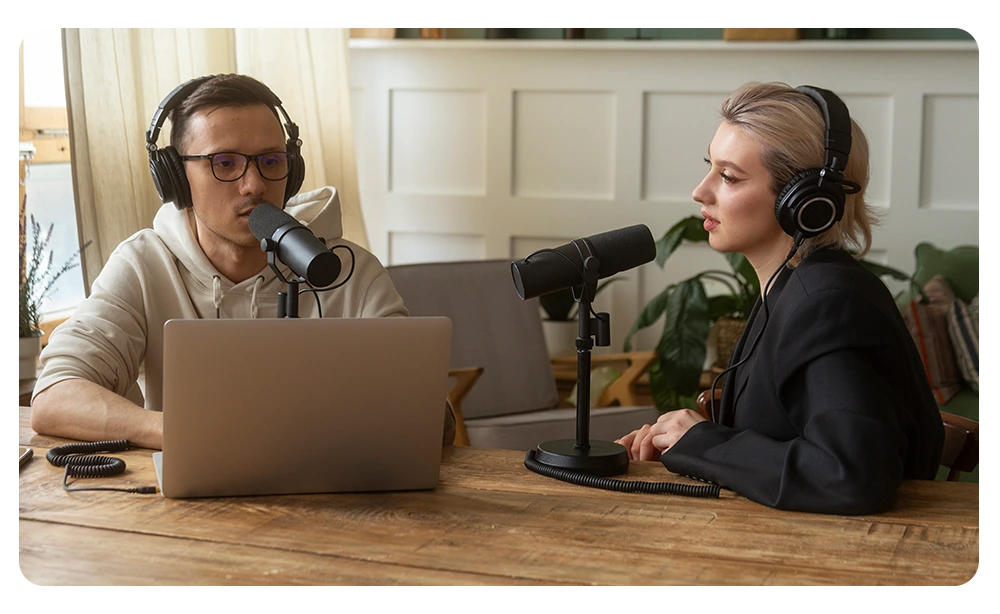
A two-host podcast setup requires more considerations. Each host needs a proper microphone and a comfortable position. The microphones also need to be placed in a way that minimizes unwanted noise and audio interference. If the podcast is recorded on video, camera positioning becomes even more important.
A professional studio can also take some of the technical pressure off production, which is why we recommend you book a session at our Dubai Podcast Studio.
Conclusion: Solo or Co-Hosted?
There’s no single permanent winner when it comes to deciding between solo vs co-hosted podcast. If independence, flexibility, and personal control matter more to you, Solo is the right choice. If you enjoy challenging conversation, presenting different viewpoints, and dividing tasks, Co-Hosted will be the better option. If both approaches appeal to you, a hybrid podcast format can let you combine the advantages of both models.
The best approach is to try both formats before making a final decision. Record one trial solo episode and one trial multi-host episode.
Then compare the preparation time, the recording process, and the final result. Also see which format you could realistically keep up consistently over the next year.
The best podcast format isn’t necessarily the one that looks more appealing on paper. The best choice is the format you can produce consistently while delivering content that’s useful, genuine, and engaging for your audience.
Frequently Asked Questions
1.Is it easier to start a solo podcast or a co-hosted one?
A single-host podcast is usually simpler in terms of coordination, since you only manage your own schedule. However, producing engaging episodes on your own may require more preparation and hosting skill. In a multi-host podcast, conversation may flow more easily, but scheduling and coordination will be more complex.
2.Can a podcast mix solo and co-hosted episodes?
Yes. A podcast can use a hybrid approach. For example, you can produce regular episodes with two hosts and release a solo episode whenever one of the hosts is unavailable.
3.Do co-hosted podcasts grow faster than solo podcasts?
Not necessarily. A podcast’s growth depends on factors such as content quality, audience fit, discoverability, publishing consistency, promotion, and audience retention.
4.How do I find the right co-host for my podcast?
Don’t focus only on friendship or a personal relationship. A good co-host needs to be committed to the project and compatible with you in terms of communication style and collaboration.
5.What happens if my co-host and I disagree on content direction?
Establish decision-making rules before disagreements arise. You can divide different responsibilities between yourselves, or agree that important decisions require approval from both people. A written agreement can also define ownership, responsibilities, branding, revenue, and the terms for one host’s departure.
6.Do I need different equipment for a solo vs. a co-hosted recording?
The main equipment categories are similar, but a multi-host show needs more microphones and recording channels. You also need to consider microphone placement, monitoring, camera framing, and each host’s audio levels.